
Kayaköy: Stone Houses, Churches and Village Life
Kayaköy has roofless stone houses, historic churches, Ottoman Greek heritage and a lived-in village beneath the hillside ruins.
Instant price
Book your transfer
Choose your route, travel date and passengers to see your fixed price.
- Fixed price
- Free cancellation
- Flight tracking
Kayaköy lies in a green inland valley in Fethiye district, between the Fethiye side and the hills rising behind Ölüdeniz. Across the slope, a protected historic settlement forms a pale lattice of roofless stone walls, lanes and church buildings. Below it, the inhabited village continues among fields, gardens, restaurants and restored homes. The shared name belongs to both places, with old masonry above and cultivated lower ground below.
Kayaköy from hillside to valley
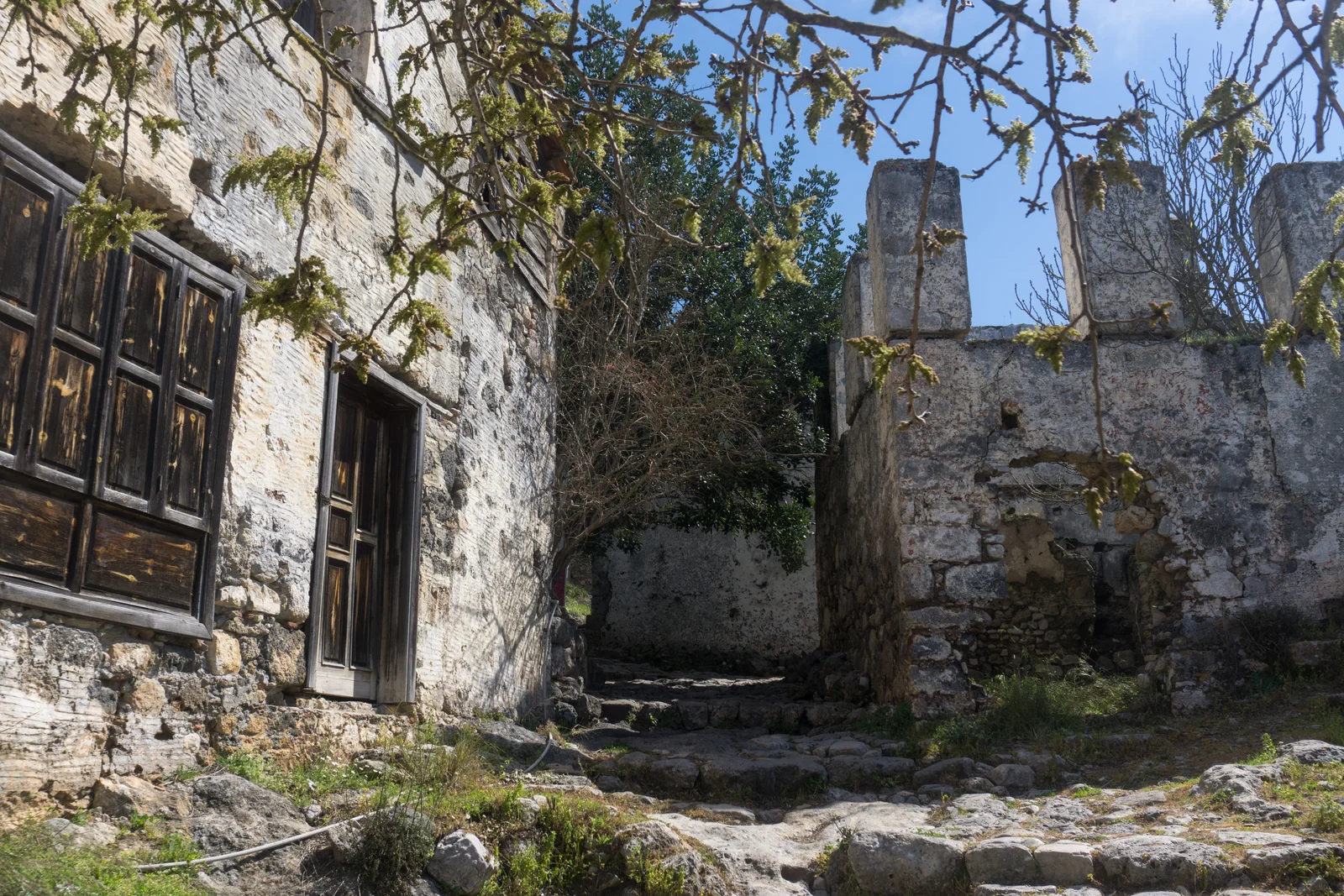
Rows of old houses follow the contours of the hillside, connected by stone-paved lanes, worn steps and small courtyards. The ground rises noticeably, and the irregular paths thread between walls that still outline former rooms. From higher points, the lived-in valley appears between cultivated plots and trees, while the historic settlement spreads across the slope in close-set terraces. This relationship between buildings and terrain is central to the site: domestic spaces, public buildings and water systems were all fitted into the incline.
Levissi and the population exchange
Before the population exchange, the historic settlement was known as Levissi or Livissi. Although the area is associated with ancient Karmylassos, most of the houses and public buildings visible today belong to the later Ottoman-period Greek Orthodox community rather than an intact ancient city.
Kayaköy’s Greek Orthodox residents left during the compulsory population exchange between Türkiye and Greece in 1923. Muslim exchangees from Greece settled in the area, though many subsequently moved elsewhere. Over the following years, empty buildings lost wooden doors, windows and roofs through natural decay, and the 1957 Fethiye earthquake caused further damage. The present ruins emerged through successive stages of departure, weathering and earthquake damage.
Inside the stone settlement
Many houses were positioned so that neighbouring buildings did not entirely block their light or outlook. Their surviving walls reveal compact rooms, lower storage areas and rainwater cisterns, practical features for life on the stony slope. Narrow lanes bend around these homes, occasionally opening into courtyards or crossing flights of steps.
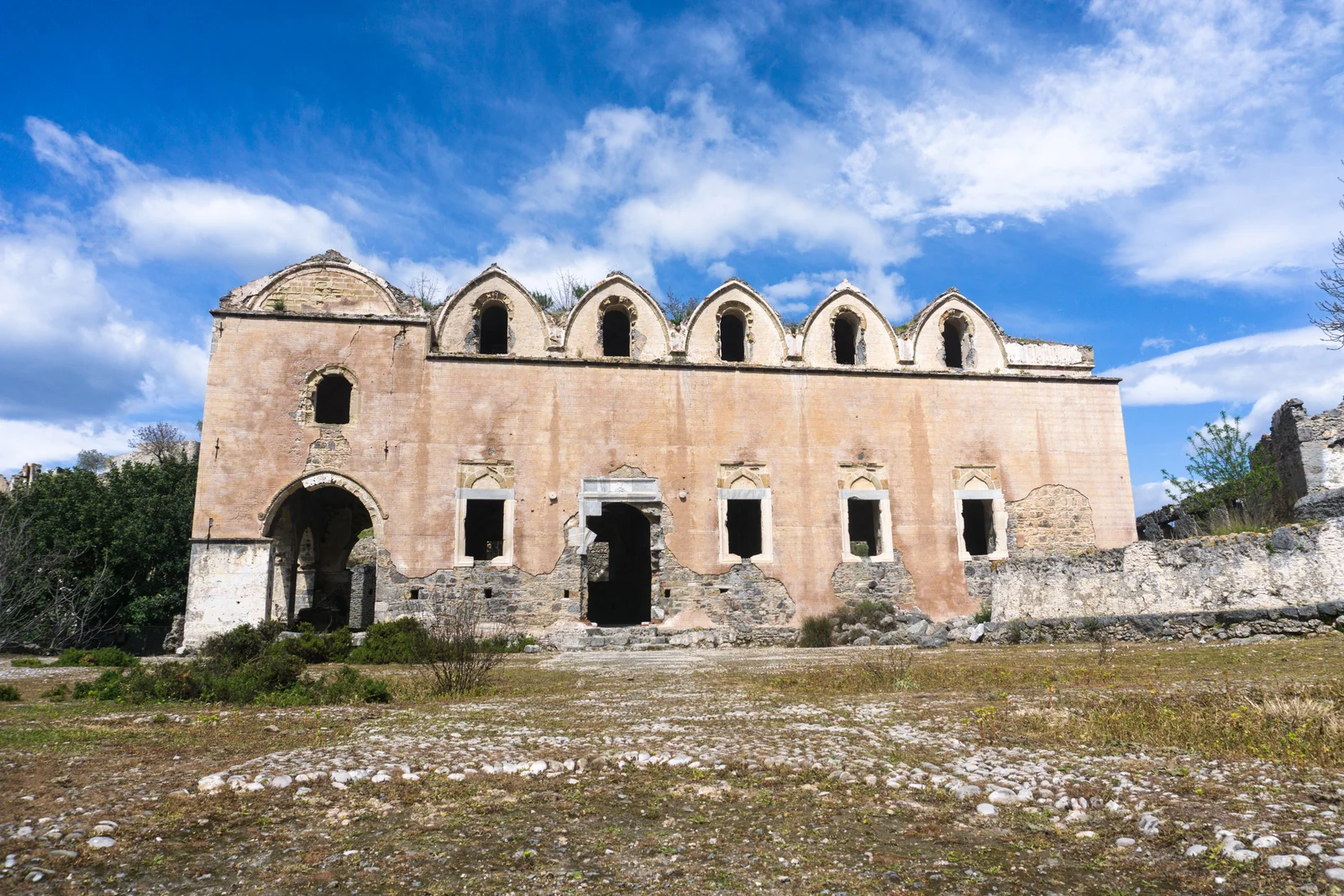
The two largest religious buildings are commonly called the Lower Church, Panayia Pirgiotissa, and the Upper Church, Taxiarhis. Their scale distinguishes them from the surrounding houses, while smaller chapels and former school buildings show that the settlement contained more than domestic architecture. These surviving buildings mark the former community’s religious and educational spaces across the hillside.
Village life beneath the ruins
On the lower ground, present-day Kayaköy includes cultivated land, restaurants and cafés alongside restored stone houses, villas and small hotels. Its accommodation remains dispersed through the village rather than forming a continuous resort strip. In the evening, village restaurants, courtyards and smaller properties become the main social spaces, with the hills enclosing the valley after daylight fades.
High summer is the hottest and busiest period. Spring and early autumn are generally milder, and spring growth often turns the valley floor and spaces around the ruins a deeper green. The pale stonework becomes more sharply defined against that seasonal growth.
Beyond Kayaköy: town, lagoon and coast
Nearby Fethiye has the district’s larger town centre, marina and rock tombs. On the other side of the hills, Ölüdeniz centres on its lagoon and beach resort area. Kayaköy remains inland, enclosed by the valley and its stone-built slopes.
Towards the coast beyond the village lie Gemiler Bay and Gemiler Island. The island preserves medieval church and settlement remains above the water, extending the area’s visible historical landscape from the inland slopes to the shore.
Dalaman Airport to Kayaköy
A private Dalaman Airport to Kayaköy taxi provides a direct transfer between the terminal and accommodation in the village. The route page brings together the live vehicle options and booking information for this connection. Travellers can arrange the journey from the airport to their accommodation before they arrive.
Ready to book your transfer?
Fixed price, meet & greet, 24/7 — get an instant quote.
Frequently asked questions
The Greek Orthodox residents of Levissi left during the compulsory population exchange between Türkiye and Greece in 1923. Later decay, the loss of wooden roofs and fittings, and damage from the 1957 Fethiye earthquake all contributed to the ruins seen today.
Kayaköy is not wholly abandoned today. The historic hillside settlement is uninhabited, while the lower village remains home to residents, cultivated plots, restaurants and small places to stay.
Rows of roofless stone houses, paved lanes, steps, courtyards and cisterns remain across the slope. The Lower and Upper Churches stand among smaller chapels and former school buildings.
The inhabited village includes cultivated land, restaurants, cafés and restored stone homes. Small hotels, villas and other low-key accommodation are dispersed across the lower ground.
Fethiye lies nearby with its town centre, marina and rock tombs, while Ölüdeniz is known for its lagoon and beach area. Gemiler Bay and Gemiler Island are on the coast beyond the village, and the island contains medieval remains.