
Kekova / Üçağız: Harbours, Ruins and Island Waters
Kekova / Üçağız encompasses Teimiussa’s harbour ruins, a partly submerged coast, and Kaleköy’s castle, theatre and Lycian sarcophagi.
Instant price
Book your transfer
Choose your route, travel date and passengers to see your fixed price.
- Fixed price
- Free cancellation
- Flight tracking
In Kekova / Üçağız, the name Kekova refers both to the long island opposite the mainland and to the wider protected coastal region of islands, narrow sea passages and deeply indented bays around Üçağız and Kaleköy. Üçağız is the harbour village built around and partly over Teimiussa, a Lycian port whose history reaches back at least to the fourth century BCE. These places form a coastal landscape where inhabited waterfronts sit beside ancient remains.
How Kekova / Üçağız fits together
Üçağız curves around a sheltered natural harbour opposite the waters between Kekova Island and Kaleköy. Boats and yachts occupy much of the waterfront, while maquis, pines and pale limestone frame the irregular shore. The wider Kaş-Kekova Special Environmental Protection Area encompasses these islands, bays, sea channels, archaeological sites and small living settlements. Its geography feels intricate at close range: headlands divide neighbouring coves, and short stretches of open water separate villages from ruins.
Harbour life among Teimiussa’s remains
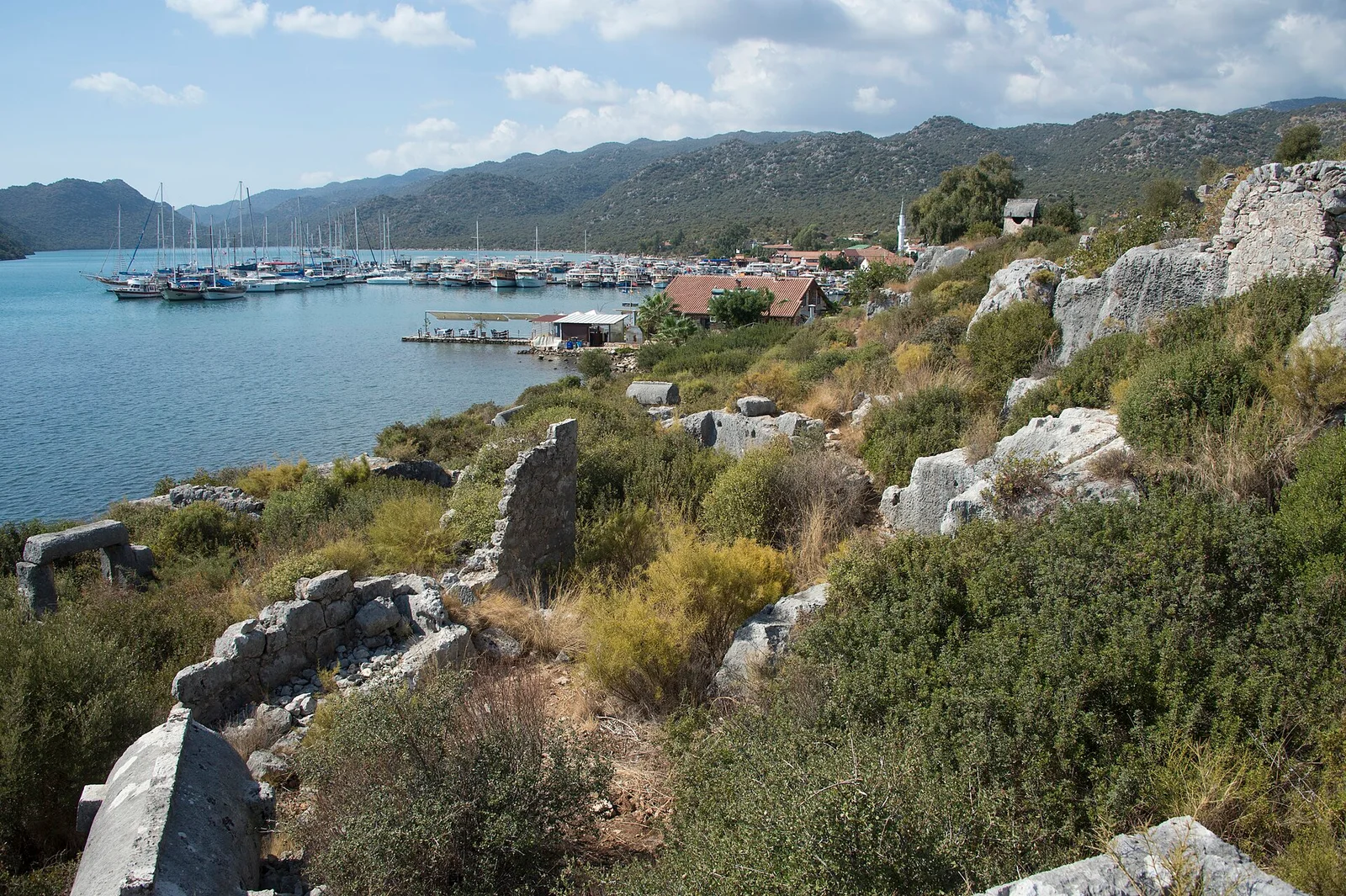
Teimiussa appears most clearly in the extensive necropolis around Üçağız. Numerous Lycian and Roman-period sarcophagi rise among the village edges and rocky ground, accompanied by rock-cut and house-type tombs, traces of a tower, a small gate and an ancient quay cut into the rock. The remains belong to more than one chapter of the settlement’s past rather than a single building phase.
Modern Üçağız remains modest in scale. Small pensions, guesthouses and low-key hotels share the harbour with restaurants and waterside terraces, creating an evening scene centred on meals and the movement of boats rather than clubs or a large resort strip. The ancient port and the working waterfront occupy the same sheltered curve, so daily village life unfolds within sight of Teimiussa’s stonework.
Kekova’s partly submerged shore
Along the north side of Kekova Island, earthquakes and gradual coastal change left ancient shoreline buildings partly below the waterline. Stone steps, house walls, quays and other structural traces appear above and below clear water when viewed from the sea. Known widely as the Sunken City, this is a broken band of coastal remains, not an intact city preserved beneath the surface.
Elsewhere on the island, Tersane Bay preserves traces linked with an old harbour or shipbuilding area as well as the apse of a Byzantine church. Akvaryum Bay and Gökkaya Bay belong to the same wider coastal setting, where narrow channels open into sheltered water between rocky shores.
Kaleköy above ancient Simena
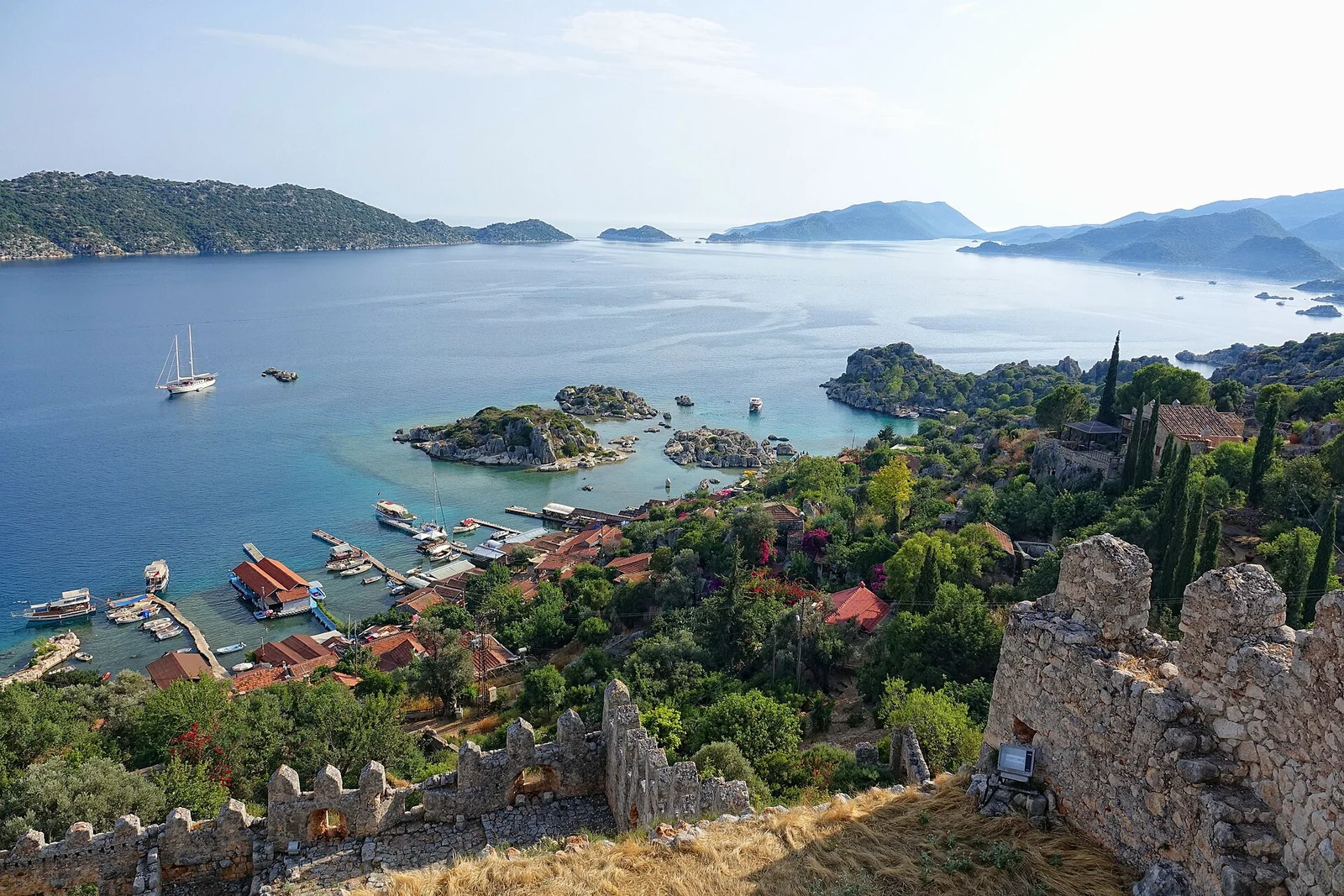
Across from Kekova Island, Kaleköy occupies the site of ancient Simena. This small Lycian coastal city is attested from at least the fourth century BCE and continued through Roman, Byzantine and medieval periods. A fortress crowns the settlement, enclosing a small theatre cut into the rock; cisterns, rock tombs, a necropolis and Lycian sarcophagi spread around the slopes. The sarcophagus standing in shallow water below the village has become its most familiar landmark.
Kaleköy has no ordinary through-road connection, and its close relationship with boats and mainland paths remains part of its geography. From the fortified heights, the view takes in village roofs, the island and the surrounding channels. High summer usually brings the greatest heat and activity to the harbour and boat routes, while spring and early autumn are generally milder.
Neighbours along the Lycian coast
Üçağız belongs to Demre, the district centre associated with Myra, Saint Nicholas and the ancient port area of Andriake near Çayağzı. Boat trips to the Kekova shore and Kaleköy commonly leave from Üçağız, with departures also operating from the Demre/Çayağzı-Andriake side. To the west, Kaş is a larger harbour town with its own accommodation, restaurants and boat departures. Each is distinct from Kekova’s smaller island-and-village setting, yet both are closely connected to its coastal history.
Private transfer from Antalya Airport
A private transfer from Antalya Airport to Kekova / Üçağız takes you directly to the mainland harbour village. You can arrange the journey to your accommodation before arrival. Current booking details are available on the linked route page.
Ready to book your transfer?
Fixed price, meet & greet, 24/7 — get an instant quote.
Frequently asked questions
Kekova can mean the long island opposite the mainland or the wider protected coastal region around Üçağız and Kaleköy. Kekova Island is the specific island, while Üçağız is the mainland harbour village built around ancient Teimiussa.
The so-called Sunken City consists of shoreline buildings that were partly submerged through earthquakes and coastal change. Stone steps, house walls, quays and other structural traces remain visible above and below the water along Kekova Island’s north side.
Boat trips commonly depart from Üçağız harbour for the Kekova coast and Kaleköy. Departures also operate from the Demre/Çayağzı-Andriake side and from Kaş.
Üçağız has small pensions, guesthouses, modest hotels, restaurants and waterside terraces rather than a continuous resort strip. Evenings tend to centre on the harbour and dinner rather than on a large nightlife scene.
Kaleköy is the modern settlement on the site of ancient Simena. The castle, rock-cut theatre, cisterns, tombs, necropolis and Lycian sarcophagi preserve evidence of its long history.